
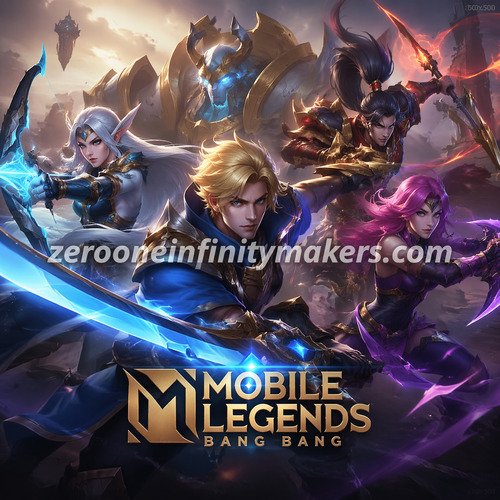
zerooneinfinitymakers.com – Mobile Legends: Bang Bang combines fast mechanical gameplay with strategic decision-making, making every match a continuous test of awareness and adaptation. Players control different heroes with unique abilities, but no hero operates independently from the rest of the team. The way a player farms, rotates, uses abilities, positions during combat, and responds to enemy movements can influence the entire flow of a match. This is why learning Mobile Legends is not simply a matter of understanding what each skill does. A player also needs to know when that skill should be used, what target should be prioritized, and whether using it now will create a disadvantage later. The same ability can have completely different value depending on the situation. A crowd-control skill used against one enemy during a minor skirmish might be less valuable than saving it for a larger team fight, while a mobility ability can be used either to engage or to escape depending on the information available. These decisions become more complex as the match progresses because heroes gain levels, purchase equipment, and become capable of producing much larger effects. Players must therefore learn how to manage the transition from laning into rotations, from rotations into objective contests, and from small skirmishes into decisive late-game encounters. Another important aspect of Mobile Legends is that players have different responsibilities depending on their roles. A tank may need to create space and protect teammates, while a marksman usually needs to maintain safe positioning to deliver consistent damage. A mage can control areas and provide burst or crowd control, an assassin may look for vulnerable targets, and a fighter can often operate between offense and defense. These roles overlap in some hero designs, but understanding their general purposes helps players make better decisions. The objective of this guide is to explain several practical concepts that can help players improve their gameplay, from mechanical execution and positioning to objective control and teamwork. Rather than depending on a single fixed formula, players can use these principles as a framework for adapting to different matches.
Improving Mechanical Control and Hero Understanding
Understanding a hero begins with learning what each ability does, but effective gameplay requires going further. Players should understand the range, timing, cooldown, resource cost, and possible combinations associated with their skills. Knowing that an ability provides crowd control is useful, but knowing how long the control lasts and how that timing interacts with teammates can make the ability much more powerful. Players should also learn which skills are best used offensively and which should be preserved defensively. A mobility skill, for example, might allow a hero to reach an enemy quickly, but using it to initiate can leave the hero without an escape option. In another situation, the same ability could be used to avoid a dangerous attack and preserve the hero for a later part of the fight. This is why skill usage should be connected to the overall situation rather than treated as a sequence that is always performed in the same order. Players should also become familiar with basic combinations. Practicing combinations in a controlled environment can make execution smoother during actual matches. However, mechanical practice should eventually include variations because opponents will not always stand in the same position. A combination that works against an isolated target may fail when additional enemies are nearby. Players should therefore practice adapting the sequence according to distance, target movement, and available escape routes. Another important part of hero mastery is understanding weaknesses. A hero may have strong burst damage but poor durability, or excellent mobility but limited sustained damage. Knowing these limitations prevents players from forcing situations where their hero is unlikely to succeed. The strongest mechanical players are not simply those who can execute skills quickly; they are also able to recognize when execution should be delayed. Patience can increase the value of an ability because waiting for the opponent to use an important defensive skill may create a better opening. Hero knowledge therefore combines mechanics, timing, and judgment. Once players understand these elements, they can use the same hero more consistently across different matchups and situations.
Practicing Movement and Attack Timing
Movement is fundamental to Mobile Legends because positioning can determine whether a player deals damage safely or becomes an easy target. Players should practice moving while maintaining the ability to attack or use abilities effectively. This is particularly important for heroes that rely on spacing. A marksman may need to continuously reposition while attacking, while a mage may need to maintain enough distance to avoid enemy crowd control. Fighters and assassins also benefit from precise movement because they often need to enter and exit combat at specific moments. Movement practice should not be limited to running toward an opponent. Players should learn how to move sideways, retreat while attacking, reposition around terrain, and avoid predictable paths. Attack timing also matters. Basic attacks and abilities can have different animations, ranges, and delays, so players should become familiar with how their hero behaves during movement. The more natural these mechanics become, the more attention can be devoted to the minimap and broader strategy. However, players should avoid assuming that mechanical speed automatically produces better gameplay. Fast movement without awareness can still lead to poor decisions. The purpose of mechanical practice is to reduce the amount of attention required for basic actions, allowing the player to concentrate on higher-level information. Players can also practice responding to enemy movement rather than simply repeating memorized patterns. If an opponent moves backward after an ability is used, the player can adjust the next action instead of continuing the original sequence. This makes mechanics more flexible. Another important area is learning the limits of movement abilities. Players should understand how far a dash or blink can travel and whether it can cross particular areas. Knowing these details can influence escape decisions during real matches. When mechanical control becomes reliable, players gain more freedom to focus on strategic choices. They can recognize an enemy rotation while moving, prepare a skill while repositioning, and maintain safer spacing during a team fight. Mechanics and strategy therefore support each other rather than functioning as separate skills.
Choosing Equipment According to the Match
Equipment choices are another part of hero mastery because item progression affects how a hero performs. A standard build can provide a useful starting point, particularly for newer players, but it should not necessarily remain unchanged throughout every match. Opposing heroes may create different threats, and the player’s own role may require different priorities depending on how the game develops. Defensive equipment can become important when an enemy consistently eliminates the player before they can contribute. Offensive equipment may be valuable when the hero needs additional damage to finish targets or pressure structures. Utility-focused options can also change how a hero interacts with fights. Players should therefore understand the purpose of their equipment instead of purchasing items automatically. The important question is what problem the next item is supposed to solve. If an enemy relies heavily on burst damage, surviving the initial attack may be more valuable than adding a small amount of extra offensive power. If opponents have strong durability, additional damage or penetration may become more relevant. Equipment decisions should also account for the hero’s natural strengths. A hero that already has strong mobility may benefit from emphasizing damage or durability, while a hero with limited escape options may need more attention to positioning and survivability. Item selection is closely connected to the current match state. A player who is ahead may have more freedom to purchase offensive options, while someone who is behind may need to prioritize stability and safe progression. These are not universal rules because different heroes and compositions can change the optimal approach. The broader lesson is that equipment should support the role the hero needs to perform at that moment. Players who learn this principle become less dependent on predetermined builds and more capable of adapting. This flexibility is particularly valuable when the opposing team changes its strategy. Instead of following an item sequence because it is familiar, players can identify the most important threat and respond appropriately. Over time, understanding equipment choices can improve both individual performance and team contribution.
Mastering Positioning and Team Fights
Positioning becomes increasingly important as team fights grow more frequent. Heroes that provide significant damage but have limited durability often need to remain behind the frontline. This does not mean they should stand completely still or remain at maximum distance from everything. They need to find a position where they can contribute damage while retaining enough space to avoid sudden attacks. Tanks and other durable heroes can help create that space by controlling enemy movement and absorbing pressure. However, back-line players should not assume that protection is guaranteed. They must still watch the minimap and recognize which enemy heroes can reach them. Assassins, mobile fighters, and certain mages may be able to bypass the frontline under the right circumstances. A marksman who ignores these threats can be eliminated before contributing significant damage. Positioning should therefore change depending on which abilities the enemy has already used. If a dangerous mobility skill is unavailable, the back line may have greater freedom. If the threat is still ready, maintaining additional distance may be safer. Players should also consider the location of teammates. A support standing far away from the damage dealer may be unable to provide assistance when it is needed. Team positioning works best when each player can contribute without becoming unnecessarily exposed. This is particularly important during objective contests, where teams may fight in confined areas. Players should avoid clustering so tightly that one enemy ability can affect several heroes simultaneously, while also avoiding excessive separation that makes coordinated defense impossible. Good positioning is dynamic. Players should move according to enemy abilities, terrain, minion waves, and the location of teammates. Learning to reposition during combat can dramatically increase survival and damage output. Instead of standing in one location until the fight ends, players can continuously search for a safer angle. This is one of the reasons mechanical movement and strategic awareness are closely related. The player needs both the physical control to reposition and the awareness to know where that position should be.
Understanding Frontline and Backline Responsibilities
Team fights become more organized when players understand that different heroes have different jobs. Frontline heroes often create space, initiate fights, interrupt enemy movement, or protect vulnerable teammates. Backline heroes usually focus on damage, healing, utility, or other forms of sustained contribution. These categories are not absolute, and some heroes can shift between roles, but the basic concept remains useful. A tank that immediately abandons the damage dealers to chase a low-health enemy may leave the back line exposed. Likewise, a marksman that moves too far forward in pursuit of a target can make the tank’s protection meaningless. Coordination means understanding how individual actions affect the entire formation. Players should also recognize that initiating a fight does not necessarily mean every teammate must follow immediately. Sometimes a tank can create pressure without fully committing, forcing the enemy to reposition. The rest of the team can then wait for a better opening. This is particularly useful when opponents have strong counter-engagement abilities. Players should also communicate their intentions when possible. Simple signals can indicate that the team should retreat, gather near an objective, or prepare to attack. Communication becomes more valuable when teammates understand the same basic plan. Another important consideration is target accessibility. The back line should not always attempt to attack the enemy back line if doing so requires walking through several dangerous abilities. Sometimes attacking the nearest accessible target is the safest and most efficient choice. Meanwhile, frontline heroes may focus on preventing enemy damage dealers from freely attacking. The fight should be viewed as a changing formation rather than a collection of independent duels. When players understand this, they become less likely to abandon their responsibilities simply because an individual target appears vulnerable. Team fights reward coordinated pressure. Every hero contributes differently, and the team’s effectiveness comes from combining those contributions at the correct time.
Managing Cooldowns During Combat
Abilities with long cooldowns can determine the outcome of a fight, which makes resource awareness extremely important. Players should avoid using every powerful ability immediately just because an enemy is nearby. Sometimes saving one key skill can be more valuable than dealing additional damage at the beginning of the engagement. This is especially true for defensive abilities and crowd control. A defensive skill may be needed when an assassin enters the back line, while a crowd-control ability may be necessary to stop an enemy from escaping. Players should therefore think about what could happen several seconds after the current action. If an ability is used now, what threat might become difficult to handle afterward? This question encourages more deliberate combat. Cooldown awareness also applies before a fight begins. If several teammates have important abilities unavailable, starting a major engagement may be risky. Waiting a short period can significantly improve the team’s chances. The same applies to enemy abilities. Players should pay attention when opponents use their most important skills because those moments can create temporary windows. However, players should not assume that an enemy without one ability is completely helpless. Other skills, basic attacks, and teammates may still provide protection. Good cooldown management is therefore about improving the odds of a favorable engagement, not guaranteeing a particular result. It also helps players avoid unnecessary skirmishes. If an important ability is unavailable and there is no urgent objective, continuing to farm or reposition may be more productive. As players gain experience, they begin to develop a sense of when a hero is temporarily weaker or stronger based on cooldowns. This awareness can influence everything from lane trades to major team fights. Learning cooldown management can therefore make gameplay feel more controlled because decisions become connected to the resources available at that exact moment.
Preparing Before Major Objectives
Major objectives can become turning points because they create reasons for both teams to gather in the same area. However, objective control often begins before the objective itself appears or becomes contested. Players can prepare by clearing nearby minion waves, purchasing needed equipment, restoring health, and positioning teammates in useful areas. Arriving early can provide more freedom than arriving after the enemy has already established control. Wave management is particularly important because an unattended lane can force someone to leave an objective area to defend a turret. Teams should therefore try to create favorable lane conditions before committing to a major contest. Players should also consider enemy visibility. If several opponents are missing, entering an objective area without information can be dangerous. A team may instead wait, check safer areas, or pressure another location until more information becomes available. Vision and positioning help determine whether starting an objective is sensible. Teams should also have an understanding of their damage resources. Some heroes can secure objectives quickly, while others are better suited to controlling the surrounding area. Assigning responsibilities naturally through hero strengths can make objective attempts more organized. Players should not all focus exclusively on the objective itself. Some teammates may need to watch for approaching enemies or control access points. This allows the team to react more quickly if opponents attempt an engagement. Objective preparation is therefore a combination of timing, wave management, positioning, and information. Players who develop these habits can contribute more effectively even when they are not the primary damage dealer. They understand that securing an objective is not simply about attacking a neutral target; it is about controlling the environment around it.
Converting Objectives Into Pressure
Securing an objective provides value, but the team still needs to use that advantage correctly. Players should consider what the objective enables them to do next. A successful objective can create an opportunity to push a lane, attack a structure, or force opponents to defend from an unfavorable position. Teams should avoid immediately scattering without a plan because the temporary advantage may disappear. At the same time, overextending can throw away the benefit. Players should evaluate their remaining health, cooldowns, minion waves, and enemy respawn timers before deciding how aggressively to continue. This is especially important after winning a team fight. The safest choice may be to take a nearby objective and reset rather than chasing the last surviving enemy across the map. Converting advantages is about turning temporary opportunities into permanent progress. Structures are particularly important because they change the amount of space the enemy can safely control. Destroying a turret can open new routes and make future rotations easier. Pushing waves afterward can increase pressure and force defenders to spend time dealing with minions. Teams should also coordinate their movement. If one player pushes a side lane while the rest of the team moves elsewhere, the enemy may have to divide its defensive resources. However, the split player must remain aware of enemy positions and avoid becoming isolated. Pressure should create difficult choices for opponents without creating unnecessary risks for your own team. Closing a match is often harder than gaining an early advantage because opponents have more powerful heroes and fewer structures to lose. Patience becomes increasingly valuable. Teams should avoid giving the enemy opportunities to recover through careless fights. A controlled approach that repeatedly creates pressure can eventually open the path toward the enemy base.
Staying Focused During the Late Game
The late game changes the importance of individual mistakes because heroes are generally more developed and the consequences of a lost fight can become much larger. Players should therefore become more cautious about unnecessary deaths. A single elimination may create enough time for the opposing team to take an objective or push a vulnerable lane. This does not mean players should stop taking fights altogether. It means that fights should have a clearer purpose. Players can ask whether the engagement is connected to an objective, structure, defensive necessity, or meaningful opportunity. If the answer is unclear, maintaining position may be better. Late-game positioning should also account for respawn times and map control. A player who moves alone into enemy territory can create a serious problem for the entire team. Grouping appropriately becomes more important because coordinated teams can punish isolated targets quickly. At the same time, waves must not be ignored. A team can lose control of a match because side lanes are continuously pushed toward its base while everyone focuses on a central objective. Players should assign responsibility naturally according to hero mobility and wave-clearing ability. Late-game decision-making also requires patience when the enemy is defending. Charging directly into a fortified position may provide little value if there is no clear opening. Instead, teams can manage waves, apply pressure from multiple directions, and wait for defensive mistakes. The objective is to create a situation where the enemy cannot comfortably respond to every threat. Players should also maintain communication during this stage because information becomes more valuable when mistakes are costly. A short warning about an enemy missing from the map can prevent a teammate from being caught. A signal to retreat can stop the team from turning a small advantage into a major setback. The late game rewards disciplined decision-making. Players who remain patient, protect important teammates, manage waves, and choose fights carefully can maintain pressure without unnecessarily exposing the team to comeback opportunities.
Conclusion Mobile Legends Gameplay Guide: How to Improve Mechanics, Positioning, Objectives, and Team Play
Improving at Mobile Legends requires a balanced understanding of mechanics, positioning, resources, objectives, and teamwork. Hero mastery begins with learning abilities and movement, but true improvement comes from understanding when those mechanics should be used and how they interact with the wider match. Equipment choices should respond to the threats and opportunities presented by the opposing team rather than being treated as completely fixed sequences. During team fights, positioning becomes critical because every hero has different responsibilities. Frontline players create space and protection, while damage dealers and other backline heroes need to maintain safe positions that allow them to contribute consistently. Cooldown management adds another layer of decision-making because powerful abilities can determine whether an engagement succeeds or fails. Beyond combat, objective preparation and map pressure provide the structure needed to turn individual advantages into meaningful progress. Teams that prepare waves, gather information, control positioning, and convert objectives carefully can create pressure without relying entirely on constant fighting. The late game then requires even greater discipline because individual mistakes can have significant consequences. Rather than trying to force every opportunity, players can focus on understanding the current state of the battlefield and choosing actions that support the team’s immediate objective. Over time, these habits make gameplay more consistent. Players begin to recognize when they are strong enough to pressure, when they need to farm, when a rotation is worthwhile, and when retreating is the better decision. Mobile Legends rewards this combination of mechanical skill and strategic awareness, and improvement comes from practicing both sides of the game. By studying heroes, refining movement, reading the map, managing resources, coordinating with teammates, and reviewing decisions after each match, players can gradually develop a deeper understanding of how to play effectively across different situations.
